
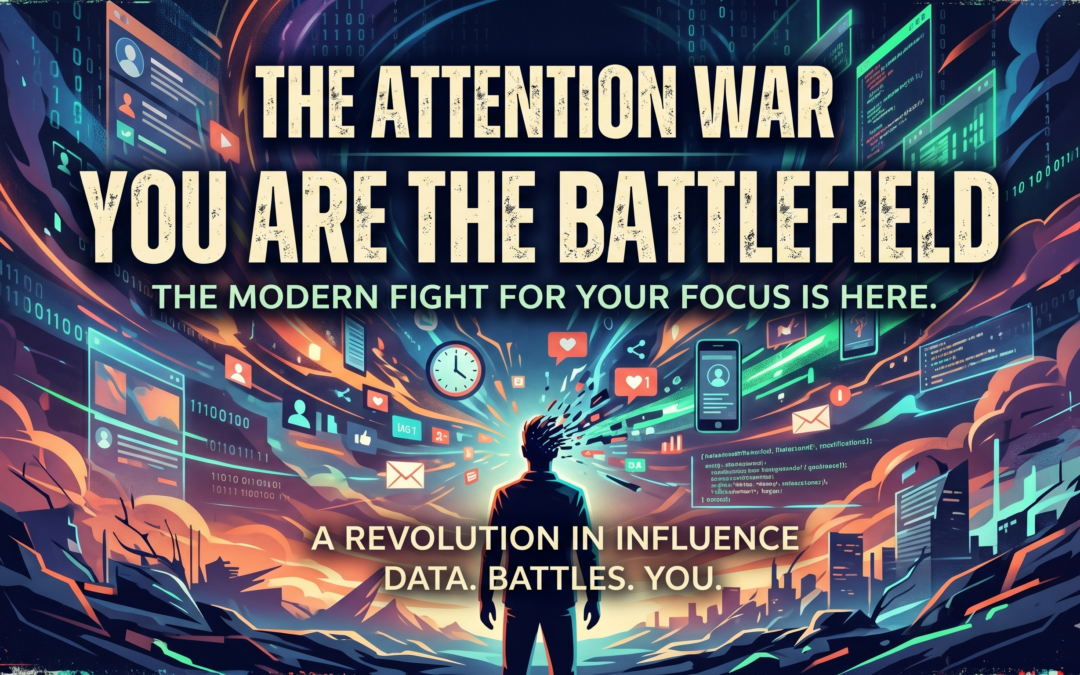
There was a time when war was measured in territory, Then it was measured in money. Then data.
Now, in the most important shift yet, it is being measured in something far less visible, and far more valuable.
Attention.
In the modern world, attention is no longer just a human faculty. It is an economic resource, a political instrument, and a psychological commodity. It is mined, harvested, optimised, and traded across global systems that most people engage with before they even finish waking up.
Every scroll, swipe, and click is part of an invisible contest. And the strange reality is this: most of humanity is no longer simply participating in the digital economy.It is being consumed by it.
A New Kind of Battlefield
Open your phone in the morning and you enter it immediately.
There are no borders, no alarms, no warnings. Just an endless stream of content designed to capture, hold, and redirect your focus.
Platforms such as TikTok, Instagram, and YouTube do not behave like neutral tools. They behave like systems of prediction, studying human behaviour at scale, refining what keeps users engaged, and learning how to extend that engagement by seconds, minutes, and hours.
The modern attention economy is not accidental. It is engineered.
And its architecture is built on one fundamental truth: whatever captures attention controls influence.
The Industrialisation of Distraction
For most of human history, distraction was incidental. A passing thought. A noise in the environment. A momentary lapse.
Today, distraction has been industrialised. Entire sectors of the global economy now depend on optimising human focus into measurable units of time. The longer a person remains engaged, the more valuable they become to the system.
What emerges is not just a media ecosystem, but a psychological one, where human behaviour is continuously observed, modelled, and subtly shaped.
The Quiet Shift: From Information to Influence
For years, the dominant narrative around technology was access. Access to information. Access to connection. Access to opportunity. But access was only the beginning.The real transformation is influence.
Companies like Google, Meta, and OpenAI operate within systems that no longer simply respond to human queries. These systems anticipate queries, shape them, and increasingly generate them.
In this environment, the line between choice and suggestion becomes harder to detect. Between desire and design, even harder.
What people believe they are deciding freely is often the outcome of thousands of micro-adjustments made by algorithms they will never see.
The Psychological Cost Nobody Is Calculating
The most overlooked consequence of the attention economy is not technological. It is psychological.
Human attention was not designed for fragmentation at this scale. It evolved for depth, survival, memory, and meaning. Yet modern digital environments reward the opposite: speed, reaction, interruption, and constant emotional switching.
Research increasingly suggests a widespread shift in human cognition:
- shorter focus spans
- heightened anxiety
- reduced capacity for sustained thought
- emotional overstimulation
- and a growing dependence on external stimulation
Humanity has become permanently connected, but increasingly internally disconnected. Not from each other.From themselves.This is not abstract for me.
I have been shaped by these outcomes myself. It has taken conscious effort to pause and recognise the faults and shortcomings in my own frame of thinking, and in my own execution. This did not happen overnight. It is the result of years of being a consumer of digital media. And even though I have spent much of my career creating content for brands and businesses, I have also become a number in the social media wheel.
It is quite alarming how far the reach of information now extends, and how easily a single person can be pulled into the gravity of it without realising. The access is extraordinary. The cost, often invisible.
South Africa Inside the Global Attention System
In South Africa, this global phenomenon takes on a specific texture.
A young, digitally active population exists within a high-pressure socioeconomic environment. For many, the smartphone is not just a device. It is entertainment, education, income opportunity, identity, and escape.
But the same systems that create opportunity also create distortion.
Outrage spreads faster than understanding. Virality often outruns truth. And digital comparison quietly reshapes ambition, self-worth, and perception of success.
Platforms amplify visibility, but not always clarity.
In that gap, something subtle happens. Attention is constantly consumed, but rarely directed.
This is not a uniquely South African problem. But it is deeply felt here.
The Next Phase: AI and the Acceleration of Attention Capture
The arrival of advanced artificial intelligence marks a turning point in this story.
The systems being developed by leading AI organisations are not just improving productivity tools or search interfaces. They are introducing a new layer of interaction between humans and information itself.
Instead of users searching for content, content will increasingly search for users.
Instead of platforms reacting to behaviour, they will begin to predict it with increasing precision.
This is where the attention war evolves.From passive capture. To active shaping.
And eventually, to real-time behavioural influence.
The Real Scarcity of the Future
Contrary to popular belief, the scarcest resource in the coming decades will not be data. It will not even be intelligence.
It will be sustained human focus.
In a world optimised for interruption, the ability to think deeply, consistently, and independently becomes a form of advantage.This is not productivity advice. It is a structural shift in how power operates.
Because whoever controls attention does not just influence what people consume. They influence what people become capable of imagining.
The Final Question
Every generation inherits a defining challenge. For some, it was industrialisation. For others, war. For others still, political transformation. This generation inherits something less visible, but no less significant. A constant battle for the human mind.
The question is no longer whether the attention war exists. It is whether individuals, societies, and nations can learn to operate within it without being consumed by it.
The answer begins where most people will not think to look. With intent. With clarity about what deserves our focus. And with the discipline to navigate, rather than drift through, the systems competing for our minds.